
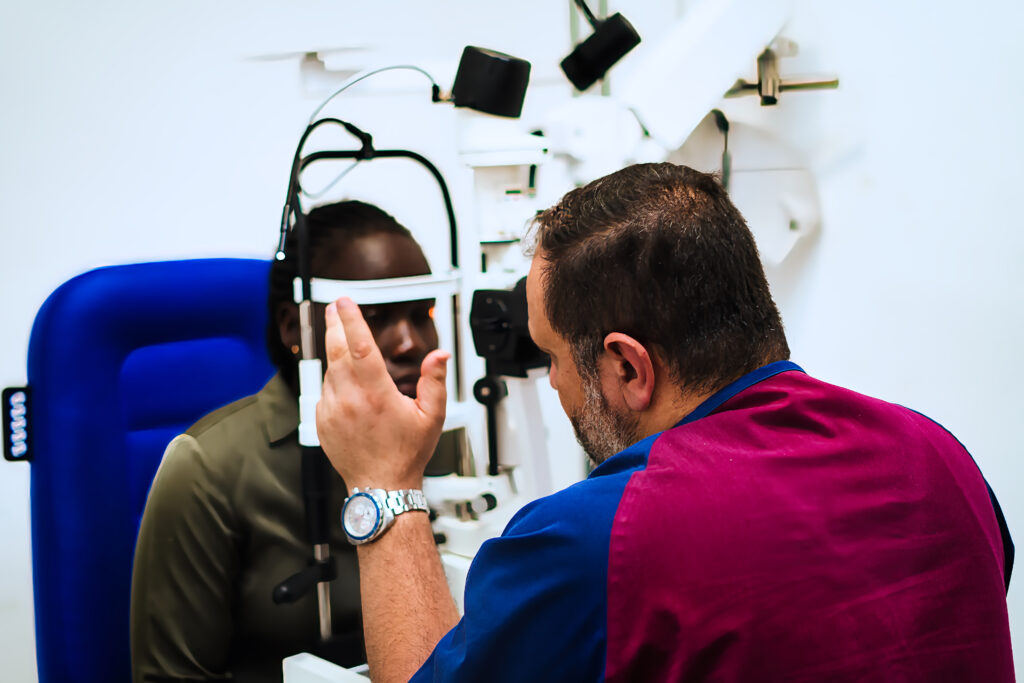
EYE SURGERY
Corneal Cross-Linking (CXL)
If you have been diagnosed with keratoconus or a corneal ectasia condition, you may have been told that your cornea is progressively thinning and weakening, causing your vision to deteriorate in ways that glasses and contact lenses can no longer adequately correct. Left untreated, progressive keratoconus can lead to severe vision impairment and may ultimately require a corneal transplant.
Corneal Cross-Linking (CXL) is the only proven treatment that can halt the progression of keratoconus, strengthening the corneal tissue and stabilising its shape before further vision loss occurs. It does not promise perfect vision or freedom from glasses, but it can stop the deterioration, preserve the vision you have and keep more invasive treatments like corneal transplantation at bay for many years or indefinitely
How It Works
Anaesthesia: Anaesthetic eye drops are applied to numb the eye completely. CXL does not require general anaesthesia in most cases. You remain awake and comfortable throughout.
- Epithelial removal (Epi-Off): For standard Epi-Off CXL, the corneal epithelium is gently removed from the central cornea using a fine instrument or dilute alcohol solution. This takes a few minutes and is painless due to the anaesthetic drops.
- Riboflavin saturation: Riboflavin (Vitamin B2) eye drops are applied to the cornea every 2-3 minutes for approximately 30 minutes, saturating the corneal stroma with this photosensitising agent.
- UVA light exposure: A controlled dose of ultraviolet A (UVA) light is applied to the cornea for approximately 30 minutes. The UVA light activates the riboflavin, triggering the formation of new crosslinks between the collagen fibres and stiffening the corneal tissue.
- Protective contact lens: A bandage soft contact lens is placed over the eye to protect the healing epithelium and reduce discomfort during the initial recovery period.
The total procedure takes approximately 60-90 minutes per eye. It is performed as a day procedure and you go home the same day.
Why Choose Royal Eye & Ear Hospital for Corneal Cross-Linking?
Corneal cross-linking requires precise technique, accurate patient selection and a thorough understanding of corneal disease. Here is why patients across Nairobi trust Royal Eye & Ear Hospital for CXL.
- 🏥● Dedicated Eye & Ear Specialists: We are a specialist eye and ear hospital. Corneal disease and advanced ophthalmic procedures are core areas of our clinical expertise, not occasional services.
- ●🔬Accurate Corneal Assessment: Before any treatment decision, comprehensive corneal evaluation including corneal topography, corneal thickness measurement (pachymetry) and slit-lamp examination is performed to confirm CXL is indicated and safe for your cornea.
- 🔬● Honest, Patient-Centred Counselling: We set clear, realistic expectations before treatment. CXL is a disease-stabilising procedure, not a vision correction treatment. We ensure every patient understands what CXL can and cannot achieve before proceeding.
- 💊 Full Pre & Post-Operative Care From your initial cataract assessment through to your follow-up appointments, our team guides you at every step — so you never feel alone in your care journey.
- 📍● Conveniently Located in Nairobi: 3rd Parklands Avenue, serving Westlands, Parklands, Gigiri, Muthaiga and across greater Nairobi.

Benefits of Corneal
Cross-Linking
Halts Keratoconus Progression
The primary and most important benefit of CXL. By creating new bonds between corneal collagen fibres, CXL stiffens and stabilises the cornea, halting the progressive thinning and bulging that causes vision to deteriorate. This is the only proven treatment that stops keratoconus in its tracks
Delays or Prevents Corneal Transplantation
- Keratoconus and post-refractive ectasia together account for approximately 15% of all corneal transplants performed. CXL can delay or even eliminate the need for corneal transplantation, which is a significantly more invasive and complex procedure with longer recovery and higher risk.
Preserves Vision at Its Current Level
- By stopping progression, CXL preserves the vision you have at the time of treatment. Some patients also experience a degree of improvement in corneal shape over time following CXL, though this is variable and cannot be guaranteed.
Keeps Future Treatment Options Open
- By stabilising the cornea, CXL keeps future treatment options available, including scleral contact lenses, intracorneal ring segments (ICRS) and refractive surgery, which may be considered after the cornea has been confirmed stable.
Minimally Invasive
- CXL is a minimally invasive procedure performed with eye drops and light. It does not involve intraocular surgery and carries significantly lower risk than corneal transplantation.
Same Day Procedure
- CXL is performed as a day procedure. You go home the same day and are typically able to return to light daily activities within a week or two.
What to Expect After Corneal Cross-Linking
Timeline:
Days 1-4: Your eye will be sore, light-sensitive and your vision will be blurred. This is completely normal and expected as the corneal epithelium heals under the bandage contact lens. Take prescribed pain relief as directed and use all eye drops as instructed. Rest with your eyes closed as much as comfortable. The bandage contact lens remains in place during this period.
Days 4-5: The bandage contact lens is removed at your follow-up appointment once the epithelium has healed. Vision may remain hazy or blurred for several more weeks as the cornea settles.
Weeks 1-4: Vision fluctuates and may be hazy, glary or blurred during this period as the cornea adjusts and heals. This is part of the normal healing process. Avoid rubbing your eye at all times during this period.
Months 1-6: Vision gradually stabilises. Some patients notice improvement in corneal shape over the months following CXL as the cornea responds to treatment. Regular topography appointments track the corneal response.
Long-term: The full effect of CXL on corneal stability is assessed over 1-2 years of follow-up. Corneal topography monitoring at regular intervals confirms that progression has halted and determines whether any additional treatment is needed.
Recovery Do's and Dont's:
✅Use all prescribed antibiotic and anti-inflammatory eye drops exactly as directed
✅Take pain relief as prescribed in the first few days
✅Wear sunglasses outdoors to protect the healing eye from UV light and bright light
✅Attend all follow-up appointments for bandage lens removal and topography monitoring
❌Do not rub your eye at any time during recovery, this is the most important rule after CXL
❌Do not swim or use hot tubs for at least 4 weeks after surgery
❌Do not wear contact lenses until advised by your surgeon
❌Do not expose your eye to water during showering or bathing for the first week
RESULTS
What Results Can You Expect?
1
Halts Progression in Most Patients
The most consistent result of successful CXL is stabilisation of the cornea, with no further progression of keratoconus on serial topography measurements. For many patients, a single treatment may halt progression permanently.
2
Some Patients Experience Corneal Improvement
Studies show that many keratoconus patients can remain stable or achieve improvement in corneal shape after CXL, which can translate to improved visual acuity and a reduction in the need for frequent contact lens prescription changes.
3
Vision May Fluctuate Before Improving
Vision may actually worsen temporarily in the weeks following CXL as the cornea heals and reorganises. This is normal. The final visual outcome is typically assessed at 6-12 months after treatment.
4
Glasses and Contact Lenses Still Required
CXL does not correct existing refractive error or irregular astigmatism. Most patients will still need glasses or contact lenses after CXL to achieve their best corrected vision. However, progression of the condition is halted, meaning prescription changes should stabilise
Risks & Considerations of Corneal Cross-Linking
CXL is a minimally invasive procedure with a well-established safety profile. At Royal Eye & Ear Hospital, our specialist team takes every precaution to minimise risk and optimise outcomes.
1
Corneal Haze
Temporary corneal haze is a normal part of the healing response and is seen in most patients in the weeks following Epi-Off CXL. In the majority of cases it resolves within 3-6 months. Persistent haze is uncommon
2
Eye Pain and Discomfort
Significant soreness and light sensitivity is expected in the first 3-5 days after Epi-Off CXL while the epithelium heals. This is managed with prescribed pain relief and usually improves rapidly once the epithelium has healed and the bandage lens is removed.
3
Temporary Vision Reduction
Vision is blurred and hazy during the healing period and may remain variable for several weeks to months. This is part of the normal healing process and resolves as the cornea stabilises.
Patient outcome note: Your ophthalmologist will discuss all potential risks clearly during your pre-operative consultation. For patients with progressive keratoconus, the risk of treatment with CXL is far outweighed by the risk of leaving the condition untreated and allowing progressive vision loss to continue toward the need for corneal transplantation.
Frequently Asked Questions About Corneal Cross-Linking
Keratoconus is a progressive condition in which the cornea thins and bulges forward into an irregular cone shape, causing distorted, blurred and worsening vision. CXL uses riboflavin eye drops and UVA light to create new bonds between corneal collagen fibres, stiffening the cornea and halting this progressive deterioration. It is currently the only proven treatment that can stop keratoconus from progressing.
CXL is primarily a disease-stabilising treatment, not a vision correction procedure. Its goal is to halt the progression of keratoconus and preserve the vision you have at the time of treatment. Some patients experience a degree of improvement in corneal shape and visual acuity after CXL, but this is variable and cannot be guaranteed. Most patients will still need glasses or contact lenses after CXL.
During the procedure, anaesthetic eye drops are used so you should feel minimal to no pain during the CXL itself. After Epi-Off CXL, significant soreness, light sensitivity and discomfort is expected in the first 3-5 days as the corneal epithelium heals. This is managed with prescribed pain relief and improves once the bandage contact lens is removed.
Typically, CXL is performed on one eye at a time to allow the first eye to heal before the second is treated. This avoids both eyes being simultaneously blurred and sore. Your surgeon will advise on the timing of the second eye based on your specific situation.
Our happy customers
We’ve helped thousands of patients
Here is what they say…

Codey Joyner
UrbanAcres, LLC
“My move was way less stressful than expected! Movely packed everything, stored it for a week, and moved it all to my new home just as promised!”

Eren Hill
H&H Legal Partners
“Movely provided a very professional service when we moved offices last month. They were easy to work with and moved everything on time.”
Emanuel Sadler
SavvyMarket
Best experience ever! I desperately needed a mover to help with a last minute relocation, and Movely was so helpful in making it a seamless process!”
Ready to Restore Your Vision?
Don’t let cataracts rob you of your independence. Our specialist team at Royal Eye & Ear Hospital is ready to help you see clearly again.
Royal Eye & Ear Hospital © 2026 All Rights Reserved.