
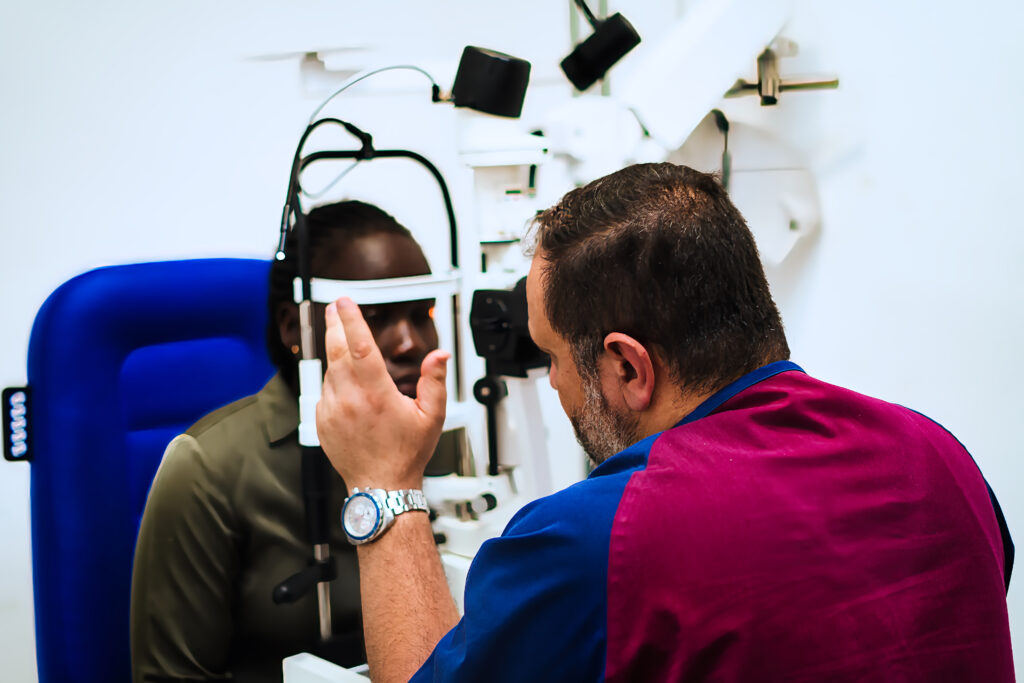
EYE SURGERY
Cataract Surgery (SICS)
Cataracts are the leading cause of blindness in Kenya, responsible for 43% of all vision loss in the country. Small Incision Cataract Surgery — commonly known as SICS — is a proven, safe, and affordable surgical technique that removes your cloudy lens and replaces it with a clear artificial one, restoring your sight often within days.
At Royal Eye & Ear Hospital, our specialist surgeons perform SICS using the most precise manual techniques available, giving patients in Nairobi and across Kenya access to world-class cataract care close to home.
How It Works
SICS involves Four precise steps:
- 1. A small incision — the surgeon creates a 5–7mm self-sealing tunnel incision at the edge of the cornea. No stitches are needed in most cases.
- 2. Lens removal — the cloudy natural lens is carefully extracted through the incision in two steps: the hard core (nucleus) is removed first, followed by the softer outer layer (cortex).
- 3. IOL implantation — a clear artificial intraocular lens (IOL) is placed inside the eye to restore focusing power.
- 4. Self-sealing closure — the incision closes naturally without sutures, reducing recovery time and infection risk.
The entire procedure typically takes 20–30 minutes and is performed under local anaesthesia, meaning you remain awake but completely comfortable throughout.
Why Choose Royal Eye & Ear Hospital for Cataract Surgery?
Not all cataract surgeries are equal. The skill of your surgeon, the quality of the lens, and the care you receive after surgery all determine your outcome.
- 🏥 Specialist Eye & Ear Focus We are a dedicated eye and ear hospital — not a general clinic. Every surgeon, every nurse, and every piece of equipment here exists solely to serve your eye health.
- 👁️ Experienced Cataract Surgeons Our ophthalmologists have performed hundreds of successful SICS procedures and are trained in the latest manual cataract techniques used across East Africa and internationally.
- 📍 Conveniently Located in Nairobi Based on 3rd Parklands Avenue, we serve patients from Westlands, Parklands, Gigiri, Muthaiga, and across the greater Nairobi region.
- 💊 Full Pre & Post-Operative Care From your initial cataract assessment through to your follow-up appointments, our team guides you at every step — so you never feel alone in your care journey.
- 🔬 Quality IOL Options We offer a range of intraocular lens options to suit your vision needs and budget, including standard monofocal lenses and premium options.

Benefits of SICS Cataract Surgery
Rapid vision restoration
Most patients notice significantly clearer vision within 24–48 hours of surgery
No stitches required
The self-sealing incision means faster healing and lower infection risk
Short procedure
Completed in 20–30 minutes as a day procedure; no hospital overnight stay needed
Safe for dense cataracts
SICS is particularly effective for advanced or mature cataracts that may be unsuitable for other techniques
Long-lasting results
Your new artificial lens is permanent and does not cloud over time
Affordable
Significantly more cost-effective than laser cataract surgery while delivering comparable outcomes
What to Expect After SICS Cataract Surgery
Timeline:
Day 1 — Immediately after surgery You will rest briefly at the hospital before being discharged the same day. Your eye will be covered with a protective shield. You may notice blurred vision or mild discomfort — this is completely normal.
Days 1–3 — First few days Vision begins to clear noticeably. Use your prescribed antibiotic and anti-inflammatory eye drops exactly as directed. Avoid rubbing your eye. Rest at home and avoid strenuous activity.
Week 1 — First week Attend your first follow-up appointment at Royal Eye & Ear Hospital. Most patients can resume light daily activities including reading and watching television. Avoid swimming and dusty environments.
Weeks 2–4 — Full recovery Vision continues to stabilise. Most patients achieve their best vision within 4–6 weeks. A final prescription for spectacles (if needed) is given at your follow-up appointment once vision has fully settled.
Recovery Do's and Dont's:
✅ Do use your eye drops on schedule
✅ Do wear your protective eye shield when sleeping for the first week
✅ Do attend all follow-up appointments
✅ Do wear sunglasses outdoors
❌ Don’t rub or press on your eye
❌ Don’t swim or get water in the eye for 4 weeks
❌ Don’t drive until your surgeon confirms your vision is adequate
❌ Don’t skip your medication even if the eye feels fine
RESULTS
What Results Can You Expect?
1
Good Visual Acuity
Most patients achieve good visual acuity within days of surgery
2
Clearer Vision
Over 78% of patients in African settings achieve good visual outcomes (VA 6/6–6/18) without spectacle correction following SICS
3
Low complication rate
SICS has a well-established safety profile with very low rates of surgical complications
4
Permanent results
Your IOL does not deteriorate over time; cataract cannot return in the treated eye
Risks & Considerations of Cataract Surgery⚠️
Like all surgical procedures, SICS cataract surgery carries a small risk of complications. At Royal Eye & Ear Hospital, our surgeons take every precaution to minimise these risks — and serious complications are rare.
1
Posterior Capsule Opacification (PCO)
The most common complication after cataract surgery. A clouding can develop behind the artificial lens months or years after surgery, causing blurred vision to return. It is not a new cataract — and it is easily and quickly corrected with a painless laser procedure called YAG capsulotomy, usually done in a single outpatient visit.
2
Infection (Endophthalmitis)
A rare but serious bacterial infection inside the eye following surgery. The risk is significantly reduced by strict surgical hygiene protocols and the use of antibiotic eye drops before and after the procedure. Early signs include increased redness, pain, or sudden vision loss — contact us immediately if you experience any of these.
3
Surgically Induced Astigmatism
The incision made during SICS can occasionally alter the curvature of the cornea, causing mild astigmatism — where vision appears slightly blurred or distorted. This is usually minor and can be corrected with spectacles or, in some cases, a follow-up procedure.
Patient outcome note: Individual results vary depending on the density of the cataract, the patient’s overall eye health, and adherence to post-operative care. Your surgeon will give you a personalised expectation at your pre-operative consultation.
Frequently Asked Questions About SICS Cataract Surgery
No. The procedure is performed under local anaesthesia — your eye is completely numbed before surgery begins. You may feel mild pressure during the procedure but no pain. After surgery, any discomfort is usually mild and well managed with prescribed medication.
The procedure itself takes approximately 20–30 minutes. You should plan to be at the hospital for 2–3 hours in total to allow for preparation, surgery, and a brief recovery observation period before discharge.
This depends on the type of IOL chosen. A standard monofocal lens typically corrects distance vision — you may still need reading glasses for close work. Premium lens options are available that can reduce spectacle dependence. Your surgeon will discuss the best option for your lifestyle at your pre-operative consultation.
SICS is suitable for most cataract patients, including those with dense or mature cataracts. Your suitability will be confirmed at a pre-operative assessment at Royal Eye & Ear Hospital where your eye health, cataract density, and overall medical history are reviewed.
Our happy customers
We’ve helped thousands of patients
Here is what they say…

Codey Joyner
UrbanAcres, LLC
“My move was way less stressful than expected! Movely packed everything, stored it for a week, and moved it all to my new home just as promised!”

Eren Hill
H&H Legal Partners
“Movely provided a very professional service when we moved offices last month. They were easy to work with and moved everything on time.”
Emanuel Sadler
SavvyMarket
Best experience ever! I desperately needed a mover to help with a last minute relocation, and Movely was so helpful in making it a seamless process!”
Ready to Restore Your Vision?
Don’t let cataracts rob you of your independence. Our specialist team at Royal Eye & Ear Hospital is ready to help you see clearly again.
Royal Eye & Ear Hospital © 2026 All Rights Reserved.